
DEADLINES
California Wildfire Statute of Limitations: Deadlines You Cannot Afford to Miss
After a wildfire, legal deadlines may not be the first thing on your mind. Most people are focused on safety, housing, insurance, and the immediate stress of loss.
Even so, timing matters. If a wildfire claim is filed too late, the right to recover compensation may be limited or lost altogether. That is why it is so important to understand the basic filing deadlines early and get legal guidance before the clock becomes a problem.
Why Deadlines Matter in Wildfire Cases
Wildfire claims often involve more than one type of loss. A family may be dealing with property damage, personal injury, smoke-related health issues, wrongful death, or claims involving a public entity, and each category can involve a different deadline.
That is what makes these cases dangerous to handle casually. A person can feel like they still have time, only to learn later that one claim had a much shorter filing window than another.
The Most Common Wildfire Claim Deadlines in California
While every case should be reviewed individually by a licensed California attorney, these are the filing periods people most often need to know.
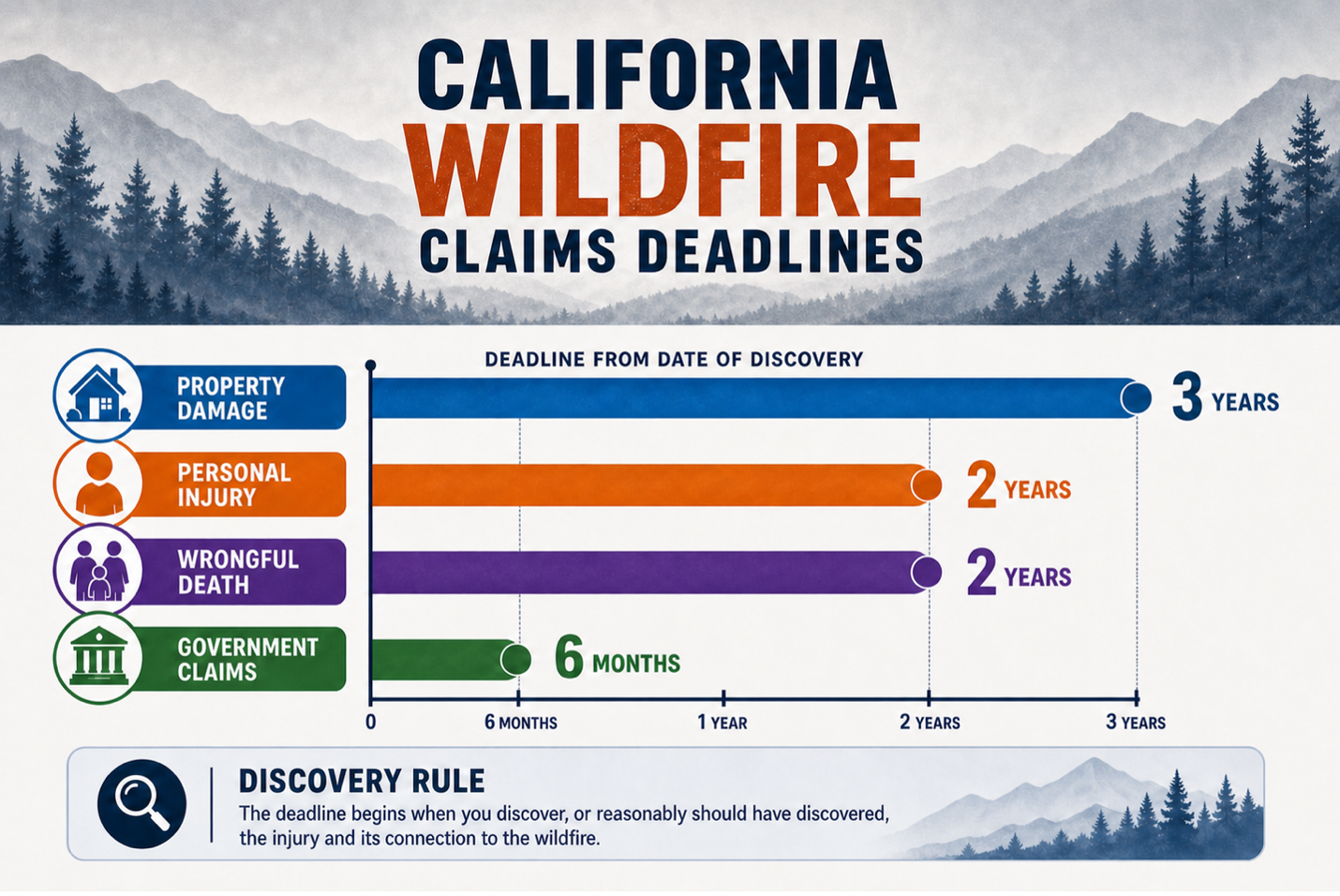
These are general California timelines, not one-size-fits-all guarantees. The exact deadline may depend on the facts, the defendants involved, and whether any exception changes when the clock starts or stops. It is essential that you speak with a California-licensed attorney about your specific case to determine what Statutes of Limitation apply to your California claims.
Property Damage Claims
In many California wildfire cases, property damage claims are subject to a three-year limitations period. That may include damage to a home, land, outbuildings, vehicles, and personal belongings.
The timing issue is not always as simple as the date of the fire. In some situations, the key question is when the damage was discovered or reasonably should have been discovered.
Why people miss this deadline
They focus only on the insurance claim and assume the legal deadline is the same.
Hidden or delayed damage is not fully understood right away.
They wait too long to investigate who caused the fire.
They do not realize that a third-party claim may run on a different track than the insurance claim.
Personal Injury Claims
Wildfire injuries may include burns, evacuation injuries, respiratory harm, and other physical or emotional injuries tied to the event. In many California cases, personal injury claims are subject to a two-year limitations period.
That can create problems for people whose symptoms develop over time or whose medical treatment continues well after the fire itself. Waiting for life to settle down can feel natural, but it can result in the Statute of Limitations running and missing the opportunity to seek compensation.
Wrongful Death Claims
When a wildfire leads to a loss of life, families may have a wrongful-death claim. In many California cases, the claim must be filed within two years.
Losing someone in a wildfire is devastating, and the last thing a family should have to navigate alone is a legal process on top of that grief. I take that seriously.
Families should not have to sort out standing, deadlines, and liability questions on their own while they are grieving.
Claims Against Government Entities
If a government agency may be involved, the timeline is often much shorter. In many situations, a claimant must first present an administrative claim within six months before any lawsuit can move forward.
This is one of the easiest deadlines to miss because it does not work like a standard civil filing period. If there is any chance a public entity played a role, that issue should be reviewed by a licensed California attorney right away.
When wildfires strike, time is of the essence. I always tell my clients, 'Don't wait to get help---your rights depend on acting quickly.'
Exceptions That May Affect the Deadline
Not every wildfire claim follows the same simple calendar. Certain legal rules can change when the limitations period begins or when it is paused for a time.
Issues that may affect timing
The discovery rule, when damage or injury is not reasonably known right away.
Tolling, in limited situations where the Statute of Limitations clock may pause.
Bankruptcy issues that can affect claim timing or case procedure.
Questions about concealment or delayed access to critical information.
Cases involving minors or other fact-specific exceptions.
These exceptions can be important, but they should not be treated as a backup plan. It is always safer to act as though the shortest possible deadline may apply until the case is reviewed carefully by a licensed California attorney.
Why Early Legal Review Helps
A wildfire deadline issue is rarely just about filing one form on time. Early legal review can also help identify the right defendants, preserve evidence, coordinate with insurance issues, and avoid settling before the full claim is understood.
That matters because wildfire cases often involve utilities, insurers, contractors, landowners, or public entities, and each of those paths may raise different timing questions.
What to Do Now if You Were Affected by a Wildfire
The best next step is not to guess. It is to get organized and treat the timeline seriously.
Save every insurance letter, estimate, receipt, and repair record.
Keep photos and videos of all visible damage.
Write down important dates, including the fire date, injury dates, and notice dates.
Do not assume the insurance process protects every legal claim.
Speak with a licensed California attorney who practices in wildfire or general civil litigation as soon as possible if major losses are involved.
Why a Personal Approach Matters
Wildfire loss is not an abstract legal problem. It is someone's home, their family, their sense of stability, and the decisions made in the early weeks can affect everything that follows.
After nearly a decade working on wildfire cases, I have seen what happens when people wait too long or assume the insurance process is enough. Deadlines pass. Options close. And by then, there is not much anyone can do.
What I can offer is direct access, honest answers, and someone who will stay on top of the timeline so you do not have to. That is what this kind of work requires, and it is what I built this practice around.
Frequently Asked Questions:
· Does the statute of limitations always start on the day of the fire?
· Is an insurance claim the same as a lawsuit deadline?
· Are claims against government agencies different?
· Should I wait until all damage is fully known?
Protect the Claim Before Time Runs Out
Statute-of-limitations issues are easy to underestimate after a wildfire. By the time the deadline feels urgent, some options may already be gone. Further, filing a lawsuit takes some time, and reaching out too close to the end of the Statute of Limitations could result in missing a timely filing.
I encourage anyone affected by wildfire to reach out as soon as possible. The sooner we connect, the better I can protect your rights and help you get the compensation you deserve.